
Quick answer: Patentable means an invention satisfies three legal requirements at the same time: it is novel (new), non-obvious (an inventive step beyond current knowledge), and useful (has a specific, real-world application). An idea that fails even one of these three tests is not patentable, regardless of how original it feels to its inventor.
This distinction trips up more first-time filers than almost any other concept in patent law. „Patentable“ is a precise legal standard, not a synonym for „novel,“ „innovative,“ or „clever.“ Founders and R&D teams routinely discover — sometimes after spending thousands of dollars on drafting — that an idea they assumed was patentable actually fails on obviousness, or that the specific claim they wanted to file was already disclosed years earlier in a conference paper nobody in their industry read. Getting this right before you commit legal budget is the entire point of a formal patentability check, and it’s what this guide walks you through.
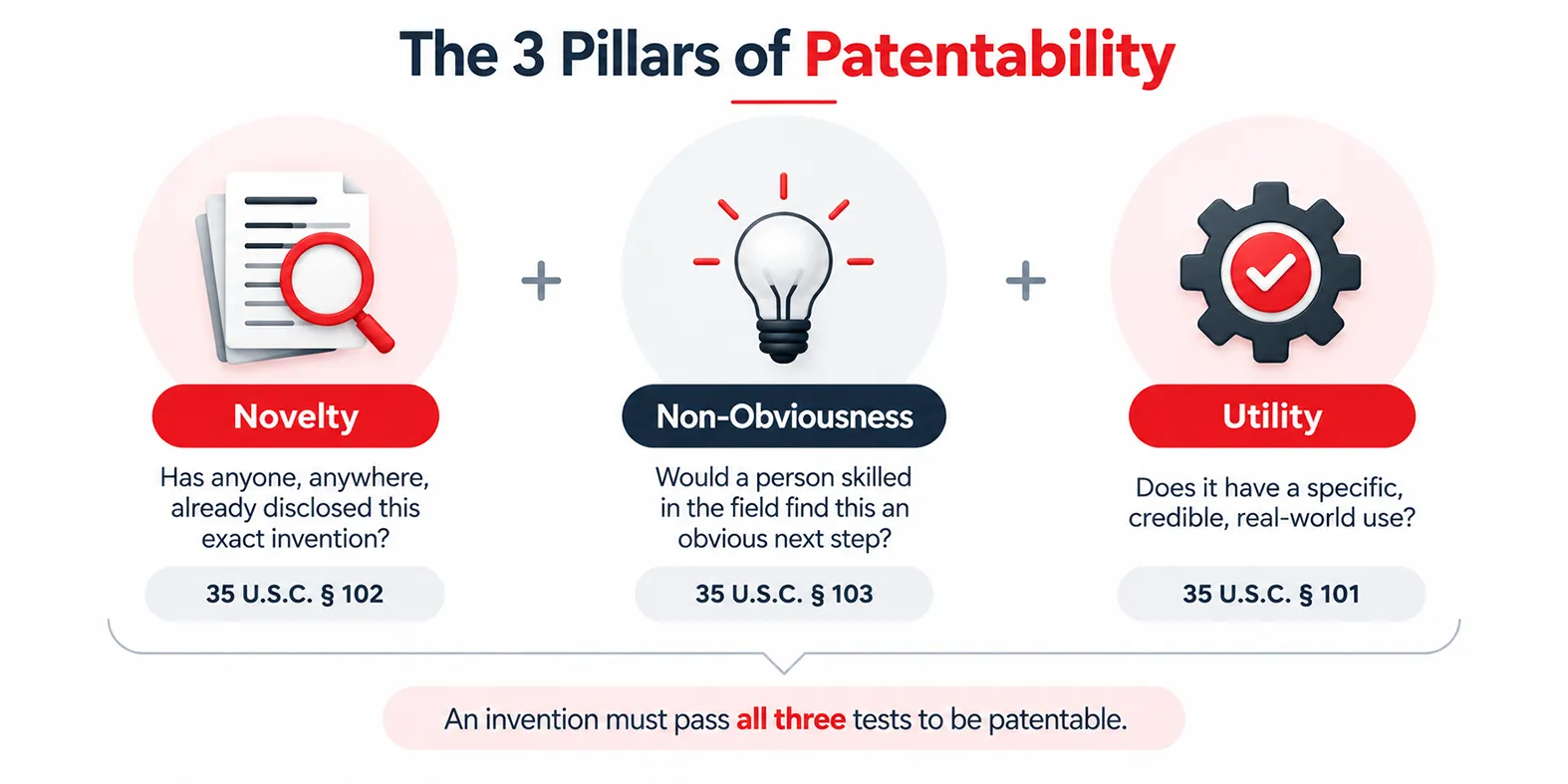
The 3 Legal Tests for Patentability
|
Test |
US Statute |
Plain-English Question |
How It’s Typically Checked |
|
Novelty |
35 U.S.C. § 102 |
Has anyone, anywhere, already disclosed this exact invention? |
A dedicated novelty / patentability search |
|
Non-Obviousness |
35 U.S.C. § 103 |
Would a person skilled in the field find this an obvious next step? |
Obviousness / inventive-step analysis against combined prior art |
|
Utility |
35 U.S.C. § 101 |
Does it have a specific, credible, real-world use? |
Subject-matter eligibility review |
An invention must pass all three at once — passing two out of three still makes it unpatentable. That’s the single most common misunderstanding in this space: inventors tend to fixate on novelty („nobody’s built this exact thing“) and skip the much harder obviousness question, which is where the majority of rejections actually happen.
1. Novelty: „Has This Been Done Before?“
An invention is novel only if no single prior-art reference — a patent, a published paper, a product, a conference talk, even a public demonstration — discloses every element of it before your filing date. Understanding what counts as prior art when applying for a patent is the essential first step, because the definition is broader than most inventors expect.
A critical, frequently misunderstood point: prior art isn’t limited to patents. Non-patent literature — academic journals, technical standards, product manuals, PhD theses, and even old marketing materials — counts just as much as an issued patent when assessing novelty. Many applications that clear a patent-only search fail later during examination because an examiner surfaces a research paper or a public product the applicant never checked. This is precisely why a thorough prior art analysis has to span both patent and non-patent sources before anyone signs off on „yes, this is novel.“
In practice, running a proper novelty check means querying global patent databases and NPL sources simultaneously, then having a human review the closest hits for whether they truly disclose every element of your claim — not just whether they’re topically similar. Our complete guide to prior art searching covers this process end to end, and how AI is solving the biggest headaches in prior art search explains why manual keyword search alone increasingly misses relevant references that a semantic, AI-driven search will surface.
2. Non-Obviousness: „Is This an Actual Inventive Step?“
This is where most rejections happen, and it’s the hardest test to self-assess because it isn’t a yes/no lookup — it’s a judgment call about how a hypothetical „person of ordinary skill in the art“ would react to your invention. An idea can be novel — technically new — and still be obvious, if a skilled person in that field would have naturally arrived at it by combining two or more existing pieces of prior art.
Examiners and litigators weigh factors like:
- Whether the combination of known elements produces a predictable result, or a genuinely surprising one
- Whether there was a documented „motivation to combine“ existing solutions in the prior art itself
- Whether the invention solves a problem others had already identified but failed to solve
- Secondary evidence: commercial success, long-felt but unsolved need, or failure of others attempting the same thing
Non-obviousness is also the test most exploited during litigation. A competitor challenging your granted patent will almost always attack it on obviousness grounds using an invalidity search that hunts for combinable prior art you may not have found during initial filing — our guide to identifying patent invalidity grounds walks through exactly how that challenge gets built, which is worth reading even at the drafting stage, because it shows you what your own patent will eventually be tested against.
3. Utility: „Does It Actually Do Something?“
The utility bar is intentionally low in US patent law, but it isn’t zero. The invention must have a specific, substantial, and credible use — an abstract idea, a law of nature, or a purely theoretical concept with no stated application will fail here regardless of novelty. Perpetual motion machines are the textbook example of an invention that fails utility outright, because the claimed function isn’t scientifically credible.
For software and AI-related inventions specifically, utility often gets bundled together with subject-matter eligibility questions under § 101 — a topic covered in more depth in our piece on IP protection for software applications, since software patentability has its own additional wrinkles beyond the standard three-part test.
Can You Patent Something to Make It Unpatentable?
A common misconception: no, filing a patent does not remove something from the public domain the way „patenting an idea to bury it“ implies. If anything, the opposite is often strategically true. Companies sometimes deliberately publish a disclosure — a defensive publication — specifically so that no one else, including competitors, can later patent that idea, because the publication itself becomes prior art the moment it’s public. Our breakdown of the elements of an effective defensive publication covers when this is the smarter move than filing, particularly for organizations more interested in freedom to operate than in exclusivity.
This connects directly to a strategic question every IP team eventually faces: is it worth patenting at all, or is freedom-to-operate — the ability to commercialize without being blocked by someone else’s patent — the more important goal? These are related but distinct questions, and conflating them is a common and costly strategic mistake.
What Is NOT Patentable
|
Category |
Example |
Why It Fails |
|
Abstract ideas |
A mathematical formula alone |
Fails § 101 subject-matter eligibility |
|
Laws of nature |
Discovering gravity |
Not an invention — a discovery of an existing law |
|
Natural phenomena |
An unmodified naturally occurring organism |
Not „made by man“ in the required sense |
|
Purely obvious combinations |
Adding a known timer to a known appliance with no new effect |
Fails § 103 non-obviousness |
|
Already-disclosed inventions |
A product identical to one sold five years ago |
Fails § 102 novelty |
If you’re wondering whether it’s possible to patent an existing product — for example, a known product used in a genuinely new way, or with a specific new modification — the answer is sometimes yes, but only the new, non-obvious modification is patentable, not the underlying existing product itself. This is a nuance worth understanding before you assume a variation on something already in the market is automatically off the table.
Why Patentability Matters Beyond the Legal Checkbox
Getting the patentability assessment right isn’t just about avoiding a rejection letter — it has real downstream financial and strategic consequences:
Filing cost efficiency. Understanding how much a patent actually costs — often running into the tens of thousands of dollars across drafting, filing, and prosecution across jurisdictions — makes it obvious why a $500–$2,000 upfront patentability check is one of the highest-ROI steps in the entire process.
Startup fundraising and valuation. For technology startups, patents are frequently a signal investors look for. Our piece on the advantages of patents for technology startups covers why a defensible, well-assessed patent portfolio can materially affect fundraising conversations.
Long-term patent value. Not every granted patent is equally valuable — our analysis of the factors contributing to the value of a patent shows that claims drafted around a rigorous novelty and obviousness assessment tend to hold up better commercially and in litigation than those drafted quickly around a shallow search.
Portfolio-level decisions. Understanding what’s genuinely patentable (versus merely filed) also matters when deciding what a patent portfolio is for and why you need one — a portfolio full of weakly patentable claims is a liability, not an asset, when it’s tested in licensing negotiations or litigation.
How to Assess Patentability Before You File: A Step-by-Step Framework
- Run a novelty search first. Use a patentability / novelty search across global patents and non-patent literature — not just a Google search of your own market — and review the output as a formal patentability search report rather than an informal list of „similar“ results
- Stress-test for obviousness. Ask whether your invention is a genuinely new combination that produces a surprising result, or just a predictable mash-up of known parts a skilled engineer would reach for anyway.
- Confirm a specific use case. Write down the exact real-world function in concrete terms; „might be useful someday“ will not satisfy the utility test.
- Get a formal patentability evaluation before committing to drafting and filing costs — this is far cheaper than discovering an obviousness problem after grant, during an expensive patent litigation proceeding.
- Consider a defensive publication if your real goal is freedom to operate rather than exclusivity — sometimes not patenting is the more strategic IP move, as covered above.
- Loop in prosecution strategy early. If the assessment comes back favorable, understanding how AI is changing patent prosecution can help you plan a faster, more efficient path from assessment to filed application.
AI-powered platforms like XLSCOUT’s patentability and novelty search can run this first-pass assessment across a massive combined patent and non-patent literature index in minutes rather than the days a fully manual search typically takes — surfacing the same combinable prior art an examiner or a future litigation opponent would eventually find, at a fraction of the traditional turnaround time. Our overview of AI in patent novelty search explains the mechanics of how this works in more depth.