


Key takeaways
- Prior art is any disclosure that made your invention available to the public before your effective filing date, in any language and any country.
- For novelty, every feature of a claim must be found in a single prior art document. Combining documents is a test of non-obviousness (inventive step), not novelty.
- Your own posts, talks and product launches can become prior art. Grace periods exist in the US and Japan (12 months) but are very limited in Europe.
- A patentability search checks whether you can get a patent. It does not tell you whether you are free to make or sell a product; that needs a freedom-to-operate (FTO) search.
Introduction
Before filing a patent, it’s essential to determine whether an invention meets the patentability criteria. Patentability refers to an invention’s ability to qualify for legal protection based on three key factors: novelty, non-obviousness, and industrial applicability.
Without a proper patentability search, an application may face rejection due to existing prior art—any publicly available patents, research papers, or product disclosures that prove the invention is not new.
A prior art search is a critical step in the patent approval process, helping inventors assess whether their idea is truly innovative. Patent offices evaluate prior art to determine if an invention meets the novelty requirement. If global prior art reveals a similar invention, the patent application may be denied or require claim modifications. Conducting a comprehensive patentability search can prevent costly rejections, legal disputes, and wasted R&D investments.
Traditional manual patent searches often rely on keyword-based lookups, but these methods have limitations, such as language barriers, database restrictions, and missed relevant prior art. AI-powered patent search tools like Novelty Checker LLM address these gaps with semantic and multilingual search.
The following sections explain what prior art is, how prior art and novelty affect patents, and how AI patentability search tools like Novelty Checker LLM can support the patent search and approval process.
What is Patentability?
Patentability is the set of legal requirements an invention must meet to be granted a patent. Patent offices such as the USPTO, EPO and JPO check that the invention is new (novelty), not an obvious step for a skilled person (non-obviousness or inventive step), and capable of industrial application or useful.
Key Requirements for Patentability
For an invention to be patentable, it must satisfy three core criteria:
- Novelty: The invention must be new and not disclosed in any prior art (patents, publications, products, or research papers). If a prior art search reveals the same invention, the application is likely to be rejected.
- Non-Obviousness: The invention should not be an obvious modification of existing technology to someone skilled in the field. Patent examiners evaluate whether the improvement is significant enough to warrant patent protection.
- Industrial Applicability: The invention must be useful and capable of being manufactured or applied in an industry, whether in technology, healthcare, or engineering.
Why Must an Invention Be New and Not Disclosed in Prior Art?
Patent offices conduct prior art searches to verify that an invention has never been disclosed before the filing date. Global prior art can exist in:
- Patent databases.
- Non-Patent Literature (NPL), including scientific papers, journals, and online documentation.
- Commercially available products, manuals, or technical specifications.
If prior art is found, the invention is not novel, leading to patent rejection or required modifications to the claims. This is why a comprehensive patentability search is essential before filing.
How Patent Offices Assess Patent Applications?
Patent examiners at USPTO, EPO, JPO, and other global patent offices follow a structured process:
- Conduct a prior art search: They check existing patents and non-patent literature to ensure the invention is new.
- Evaluate novelty and non-obviousness: The examiner determines whether the invention adds something significantly new to existing technology.
- Check legal and technical compliance: The application must meet formatting, clarity, and industrial applicability requirements.
Patent applicants who fail to conduct a thorough patentability search often face rejections, office actions during patent prosecution, and costly resubmissions. Using AI patent search tools like Novelty Checker LLM helps innovators identify potential prior art early, with AI-driven semantic search, contextual analysis, and ranked prior art results.
What is Prior Art?
Prior art is any evidence that an invention was already available to the public before the effective filing date of a patent application. It includes patents, published patent applications, non-patent literature, products, public use, and written, oral or online disclosures, in any language and from any country. Examiners use it to judge novelty and non-obviousness.
In the United States, the statutory basis is 35 U.S.C. 102(a)(1): a person is not entitled to a patent if “the claimed invention was patented, described in a printed publication, or in public use, on sale, or otherwise available to the public before the effective filing date of the claimed invention.” Under 35 U.S.C. 103, a patent is also refused if the claimed invention “as a whole would have been obvious before the effective filing date” to a person having ordinary skill in the art.
What Qualifies as Prior Art?
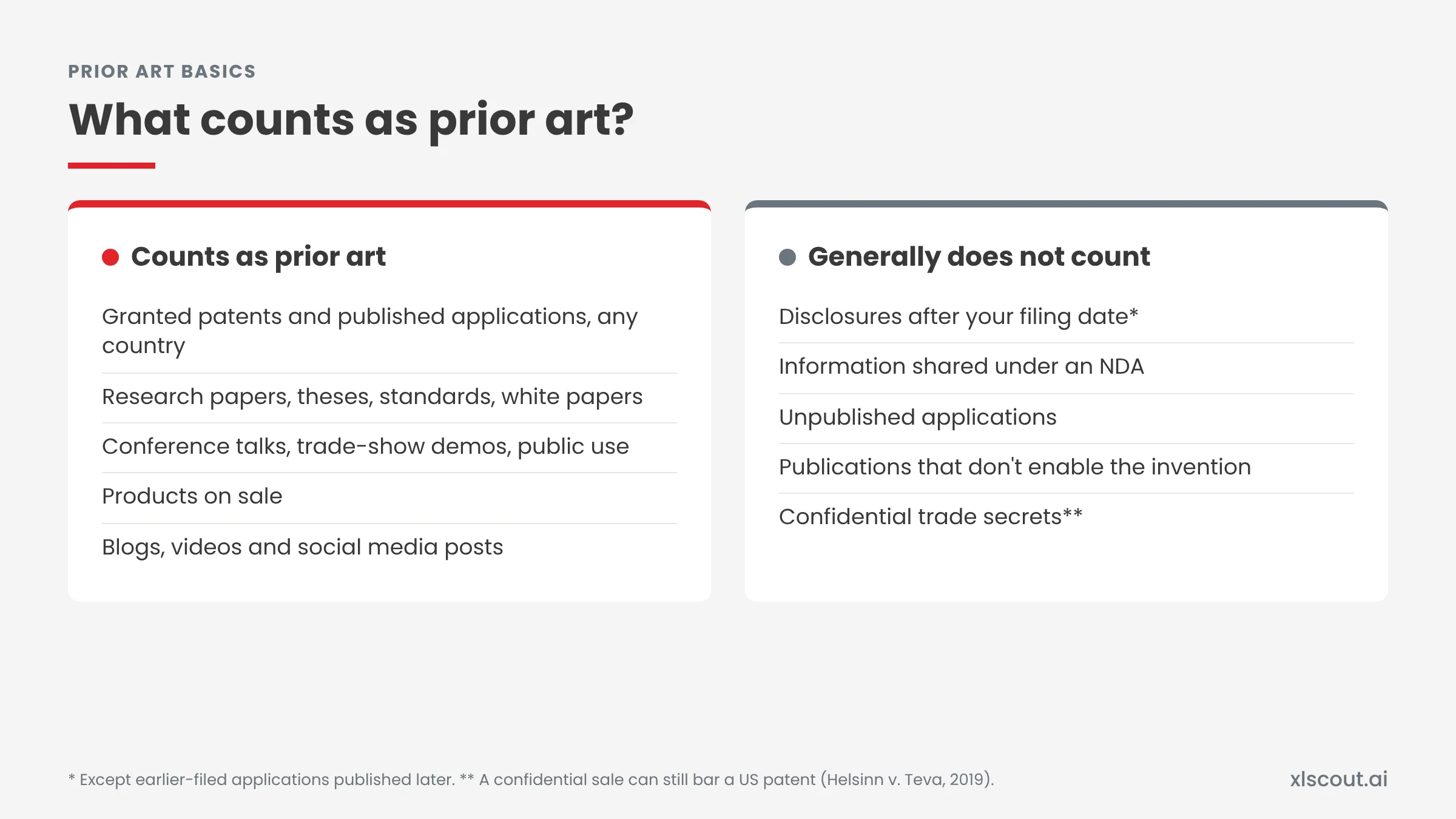
Many people assume prior art is limited to granted patents and products on the market. In practice, any document or disclosure in the public domain that existed before the effective filing date can count, if it covers the main elements of the invention. Examples include:
- Granted patents and published patent applications from any patent office.
- Research papers, theses, standards, white papers and technical reports.
- Presentations at conferences, trade shows and other public events.
- Public use or demonstration of the invention, and products offered for sale.
- Articles, newsletters, videos, blog posts, social media posts and any other internet publication.
What Does Not Qualify as Prior Art?
- Disclosures made public after your effective filing date, with one exception: patent applications filed before yours but published after it can still be cited against novelty (35 U.S.C. 102(a)(2) in the US; Art. 54(3) EPC in Europe).
- Publications that are not an enabling disclosure, meaning they do not describe the invention well enough for a skilled person to make or use it.
- Unpublished applications, for example a provisional application that was never converted into a non-provisional application and never published.
- Information shared under a confidentiality obligation, such as under a non-disclosure agreement, and trade secrets that remain confidential. Note: in the US, a confidential sale of the invention can still bar a patent under the on-sale provision (Helsinn v. Teva, US Supreme Court, 2019).
Can a Public Disclosure on Social Media Count as Prior Art?
Yes. A social media post, video or blog that describes your invention is a public disclosure and can be cited as prior art against your own application. Whether it is fatal depends on the jurisdiction: the US and Japan allow a 12-month grace period for the inventor’s own disclosures, while Europe allows only narrow exceptions.
| Jurisdiction | Grace period for the inventor’s own disclosure | Source |
|---|---|---|
| United States | Disclosures made 1 year or less before the effective filing date by the inventor (or someone who obtained it from the inventor) are not prior art. | 35 U.S.C. 102(b)(1) |
| Japan | 1 year from the disclosure (for applications filed on or after 9 June 2018). The exception must be claimed at filing, with proof filed within 30 days. | Japan Patent Act, Art. 30 |
| Europe (EPO) | No general grace period. Only disclosures within 6 months before filing that result from evident abuse or display at an officially recognised international exhibition are disregarded. | Art. 55 EPC |
The safest practice is to file before any public disclosure, especially if protection in Europe matters.
How Prior Art Searches Help in Determining Novelty and Patent Validity?
A prior art search is a critical step before filing a patent application. It helps in:
- Assessing Novelty: Ensures that the invention is new and not previously disclosed.
- Validating Patent Claims: Helps refine patent claims to avoid overlaps with existing technology.
- Reducing Rejection Risks: Avoids unexpected patent office rejections by identifying potential conflicts early.
- Strengthening Patent Applications: Helps inventors build stronger, well-differentiated claims.
Without a thorough prior art search, applicants risk filing weak patents that can be challenged, invalidated by prior art, or rejected during prosecution.
Common Sources of Prior Art
1. Patent Databases: Patent examiners search existing patents and published applications in global patent databases, including:
- XLSCOUT – XLSCOUT’s proprietary database with 170M+ patents (see XLSCOUT data coverage)
- USPTO – United States Patent and Trademark Office
- EPO – European Patent Office (Espacenet)
- JPO – Japan Patent Office (J-PlatPat)
- CNIPA – China National Intellectual Property Administration
- WIPO – World Intellectual Property Organization (PCT applications)
These databases contain millions of patent documents, but manual searches may miss relevant prior art due to keyword variations and regional language differences.
2. Non-Patent Literature (NPL): Prior art is not limited to patents—scientific and technical publications can also impact patentability. Common NPL sources include:
- XLSCOUT’s proprietary database with 220M+ non-patent literature records
- Scientific journals and research papers (IEEE Xplore, Google Scholar, PubMed)
- Technical standards (for example IETF standards documents)
- Product manuals and user guides
- Technical reports, industry white papers, and academic theses
3. Public Disclosures and Existing Products: If an invention has already been publicly disclosed, it loses novelty. Examples include products already on the market, presentations at conferences or trade shows, and online forums, blogs, or press releases. Patent examiners check publicly accessible information to determine whether the invention was previously disclosed.
Search Techniques That Find More Relevant Prior Art
- Semantic (AI) search: as explained in semantic vs keyword search in patent prior art, enter the inventive statement or draft claim elements and let an AI model retrieve conceptually similar documents, even where the wording differs.
- Citation chasing: once you find a relevant document, review the documents it cites (backward citations) and the documents that cite it (forward citations).
- Start from known portfolios: if the applicant already holds patents in the same technology, their cited references are a useful starting point for the search.
- Adapt the strategy to each database: classification codes (IPC, CPC), field codes and query syntax differ between databases.
Why Are AI Prior Art Searches Essential?
Traditional prior art searches are often manual, keyword-limited, and regionally restricted. AI-powered tools like Novelty Checker LLM improve prior art discovery by:
- Performing AI-driven semantic searches, identifying conceptually similar patents and NPL.
- Searching 170M+ patents and 220M+ NPL records from 106 jurisdictions.
- Eliminating language barriers by analyzing multilingual prior art.
How Novelty Impacts Patent Approval?
What is Novelty and Why is it a Key Requirement for Patentability?
Novelty means the claimed invention has not been disclosed in any single item of prior art before the patent application’s effective filing date. It is the first test an examiner applies: if one earlier document already describes every feature of the claim, the claim is not new and cannot be granted.
To qualify as novel, an invention must:
- Not be identical to any prior art.
- Offer a new feature or improvement over existing technologies.
- Be unpublished and undisclosed in any public domain before the patent filing date (subject to the grace periods described above).
Does Novelty Have to Be Found in a Single Prior Art Reference?
Yes. To destroy novelty, every feature of the claim must be disclosed in one prior art document. Examiners may not combine separate documents when assessing novelty; combining documents belongs to the assessment of inventive step (non-obviousness). The USPTO, the EPO and the PCT Guidelines all apply this single-reference rule.
- United States: “A claim is anticipated only if each and every element as set forth in the claim is found, either expressly or inherently described, in a single prior art reference” (MPEP 2131, citing Verdegaal Bros. v. Union Oil, 1987).
- PCT (WIPO): the PCT International Search and Preliminary Examination Guidelines state that “it is not permissible to combine separate items of prior art together” when assessing novelty (paragraph 12.06).
- Europe (EPO): the EPO Guidelines (G-VI, 1) apply the same rule and add that separate embodiments within one document also may not be combined.
The PCT Guidelines list limited exceptions: a document that explicitly refers to a second document can be read together with it to the extent indicated, a dictionary may be used to interpret terms, and further documents may be used as evidence that a feature was inherent in the primary document.
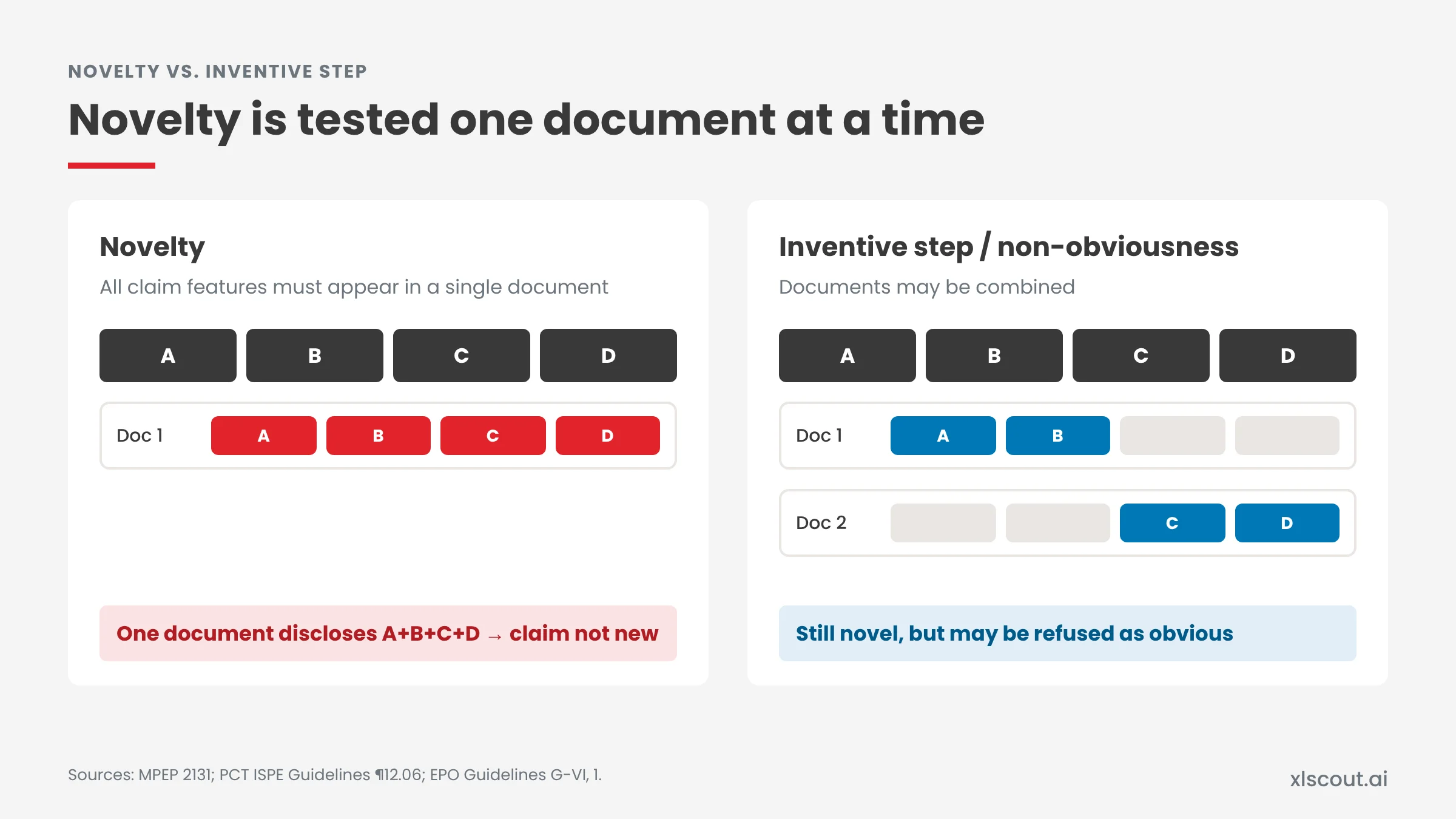
| Novelty | Inventive step / non-obviousness | |
|---|---|---|
| Question asked | Is every feature of the claim disclosed in one earlier document? | Would the claim have been obvious to a skilled person in view of the prior art? |
| Documents compared | One document at a time | Several documents may be combined |
| US provision | 35 U.S.C. 102 | 35 U.S.C. 103 |
| Typical outcome if failed | Rejection for anticipation (lack of novelty) | Rejection for obviousness (lack of inventive step) |
How Lack of Novelty Leads to Patent Rejections?
If an invention is not novel, it will be rejected by patent examiners during examination. Common reasons for rejection include:
- Identical Prior Art Found: If an examiner finds a single earlier document that describes the same invention, the claim is rejected for lack of novelty.
- Obvious Combination of Prior Art: If two or more prior art references combined make the invention obvious, the claim is rejected under the non-obviousness (inventive step) requirement.
- Public Disclosure Before Filing: If an inventor publicly discloses the idea (for example in research papers, trade shows, or online forums) before filing, it may be considered prior art against their own application unless a grace period applies.
Without a thorough novelty search, applicants risk filing weak patents that are easily challenged, opposed, or invalidated.
Examples of How Prior Art Can Challenge Novelty in a Patent Application
Example 1: Patent Overlap in the Same Field. An inventor applies for a new AI-driven drug discovery method. The patent examiner finds a similar AI-based pharmaceutical patent filed two years earlier. Since the core technology is already documented, the application is rejected for lack of novelty.
Example 2: Non-Patent Literature as Prior Art. A company develops a wireless charging system for electric vehicles (EVs) and files for a patent. A research paper from an academic journal, published three years earlier, describes a similar charging concept. The patent is rejected because the research paper qualifies as prior art.
Example 3: Self-Disclosure Leading to Rejection. A startup publicly announces its new blockchain-based financial security algorithm before filing a patent. Because the announcement was made before the filing date, it becomes prior art. In Europe this would usually be fatal; in the US or Japan the startup may still rely on the 12-month grace period if it files in time.
How AI Patent Novelty Searches Improve Patent Success?
Traditional manual novelty searches often miss important prior art, leading to unexpected rejections. Online AI patent novelty search tools like Novelty Checker LLM improve patentability assessment by conducting AI-powered semantic searches to find conceptually similar prior art. By using AI novelty searches, inventors can avoid costly mistakes, strengthen patent claims, and improve their chances at global patent offices.
Conducting a Patentability Search to Avoid Rejections
Filing a patent application without conducting a thorough patentability search increases the risk of rejections, legal disputes, and wasted investments. A patentability search helps determine whether an invention is novel by identifying prior art that may already disclose the same or similar concepts. This search is crucial for inventors, businesses, and patent professionals to:
- Confirm novelty before investing in the patent filing process.
- Strengthen patent applications by refining claims based on search findings.
- Decide early whether to file, redesign, or keep the invention as a trade secret.
Note that a patentability search does not tell you whether you can make or sell a product without infringing someone else’s patent. That question needs a separate freedom-to-operate (FTO) search; see what freedom to operate means for product and IP teams.
A comprehensive patentability search includes global patent databases, non-patent literature (NPL), and expired patents to ensure that no relevant prior art is overlooked.
Step-by-Step Process to Check if an Invention is Novel
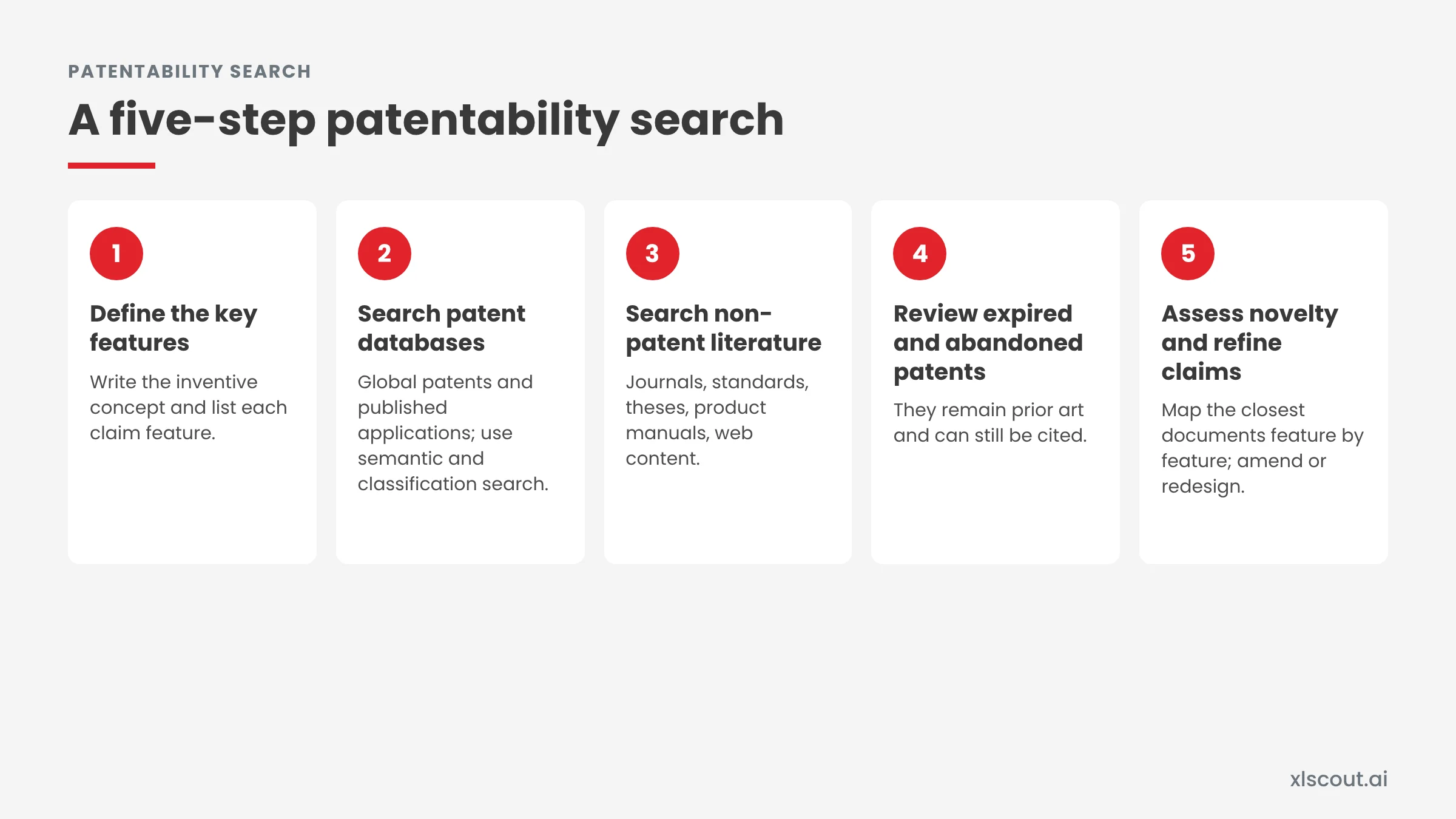
1. Searching Global Patent Databases. The first step in a patentability search is reviewing existing patents and published applications in international databases. Traditional keyword-based searches may miss relevant results due to keyword variations and technical synonyms, different patent classification codes (IPC, CPC), and language barriers in non-English patents. Online AI patentability search tools like Novelty Checker LLM, which use semantic search and multilingual analysis, help broaden the results.
2. Using Non-Patent Literature (NPL) Sources. Not all prior art is found in patent databases. NPL includes scientific journals and research papers (Google Scholar, IEEE, PubMed), technical reports, white papers and product manuals, and industry blogs, press releases and conference proceedings. Patent offices consider NPL as valid prior art, which means a publicly available research paper or blog post can defeat a patent application.
3. Reviewing Expired or Abandoned Patents. Expired patents enter the public domain and can serve as a foundation for innovation. Published applications that were later abandoned remain prior art and can still be cited during examination. Searching them helps refine an invention’s novelty and non-obviousness.
Common Mistakes to Avoid in a Patentability Search
For a longer list, see common mistakes in patent searches.
- Focusing Only on USPTO or EPO: Patent examiners review global prior art, so ignoring JPO, CNIPA, WIPO, and other jurisdictions can lead to missed results.
- Relying Solely on Keyword-Based Searches: Traditional Boolean searches may overlook conceptually related prior art due to different technical terminology.
- Ignoring Non-Patent Literature (NPL): Research papers, product manuals, and online content can serve as prior art, leading to unexpected patent rejections.
What to Do If You Find Prior Art Close to Your Invention
Finding prior art is normal; almost every invention has some. What matters is the difference between your invention and the closest prior art. Identify the features the closest documents do not disclose, then decide whether to amend the claims around those features (AI drafting tools such as Drafting LLM can help with claim language), redesign the invention, or not file.
- Map the closest documents feature by feature (a thorough prior art analysis) against your draft claims to see which features are actually new.
- Watch for competing prior art: a single problem can have several solutions, and documents describing alternative solutions can still narrow what you can claim.
- Disclose known prior art where required: in the US, applicants have a duty to disclose information material to patentability to the USPTO (37 CFR 1.56).
How AI Patentability Search Tools Like Novelty Checker LLM Improve Accuracy?
Novelty Checker LLM, powered by Generative AI and Large Language Models, supports patentability searches by:
- Scanning 170M+ patents and 220M+ Non-Patent Literature (NPL) records from 106 jurisdictions.
- Using AI-driven semantic search to find conceptually similar prior art, reducing false negatives.
- Offering search capabilities in foreign languages, reducing language barriers.
How Novelty Checker LLM Improves Patentability Assessments?
Traditional patentability searches rely on manual keyword-based searches, which often miss critical prior art due to language barriers, technical terminology variations, and limited search scope. Novelty Checker LLM, an online AI prior art search tool, uses Generative AI, Large Language Models (LLMs), and XLSCOUT’s proprietary ParaEmbed algorithm to deliver faster and more precise patentability assessments.
How AI Enhances Patent Searches?
1. ParaEmbed Algorithm for Ranked Prior Art Results. One of the biggest challenges in patent searches is filtering through thousands of results to find the most relevant prior art. The ParaEmbed algorithm analyzes patent claims, abstracts, and citations to prioritize highly relevant prior art at the top of the results, reducing time spent on irrelevant matches.
2. AI-Powered Semantic Search for Broader and More Accurate Novelty Assessments. Traditional searches rely on exact keyword matches, often missing conceptually related inventions. Novelty Checker LLM uses semantic search, which understands the meaning behind a query rather than matching words. For example, a search for “wireless EV charging system” can also retrieve patents on “inductive vehicle charging” and “autonomous power transfer for electric cars”, even if the exact wording differs.
3. Multilingual Search Capabilities for Accessing Global Prior Art. Many patents are published in languages other than English, making it difficult for manual searches to capture foreign-language prior art. Novelty Checker LLM reduces language barriers by conducting multilingual searches.
Why AI Patent Searches are Faster, More Reliable, and More Comprehensive?
- Speed & Efficiency: AI processes millions of patents in seconds, compared to weeks of manual searching.
- Higher Accuracy: Context-aware AI models identify conceptually similar patents, reducing the risk of missed prior art.
- Global Coverage: Searches across patent and non-patent literature in multiple languages.
- Enhanced Decision-Making: AI ranks prior art by technical relevance, so the most critical results appear first.
Conclusion
Conducting a thorough prior art search and novelty assessment is crucial for securing a strong, enforceable patent. Patent offices examine prior art to determine whether an invention is new and non-obvious, and novelty is judged against each prior art document on its own. Missing relevant prior art, including your own earlier disclosures, can lead to rejections, legal disputes, or invalidation.
Traditional manual patent searches often struggle with language barriers, keyword limitations, and incomplete prior art discovery. AI patentability analysis tools like Novelty Checker LLM address these gaps with semantic search, ParaEmbed-ranked prior art results, and multilingual search capabilities.
Explore Novelty Checker LLM to run a prior art and novelty search before you file.