

Quick answer: Patent competitive intelligence (CI) is the ongoing practice of monitoring, analyzing, and benchmarking competitors’ patent filings to inform R&D, licensing, and market strategy. Unlike a one-off « competitive landscape report, » effective CI is a continuous cycle — monitor new filings, analyze what they reveal about competitor direction, benchmark your own portfolio against theirs, and act on the gaps you find.
Most teams treat competitive intelligence as a project with an end date: commission a landscape report, present it to leadership once, file it away. That’s the single biggest reason CI initiatives lose executive support after 6–12 months — a landscape report is a snapshot, and snapshots go stale the moment competitors file their next disclosure. The framework below is what we recommend to R&D leaders, IP counsel, and corporate strategy teams who want CI to survive past its first presentation.
Competitive Intelligence vs. Competitive Benchmarking: What’s the Difference?
These two terms get used interchangeably, but they answer different questions, and conflating them is why so many CI programs produce reports nobody acts on:
Competitive Intelligence | Competitive Benchmarking | |
Core question | « What are competitors doing, and why? » | « How do we compare to competitors on specific metrics? » |
Output | Trends, strategic signals, early warnings | Scores, rankings, gap analysis |
Time orientation | Forward-looking (where is the market heading) | Point-in-time comparison (where do we stand today) |
Typical cadence | Continuous monitoring | Periodic (quarterly/annual) |
Example question | « Is Competitor X pivoting into a new technology area? » | « How does our patent portfolio’s citation strength compare to Competitor X’s? » |
In practice, mature IP teams run both together: benchmarking gives you the scorecard, intelligence tells you why the scorecard is changing. Our deeper look at why competitive intelligence is important and the companion piece on gaining a competitive advantage through the 7 elements of CI both expand on this distinction with worked examples.
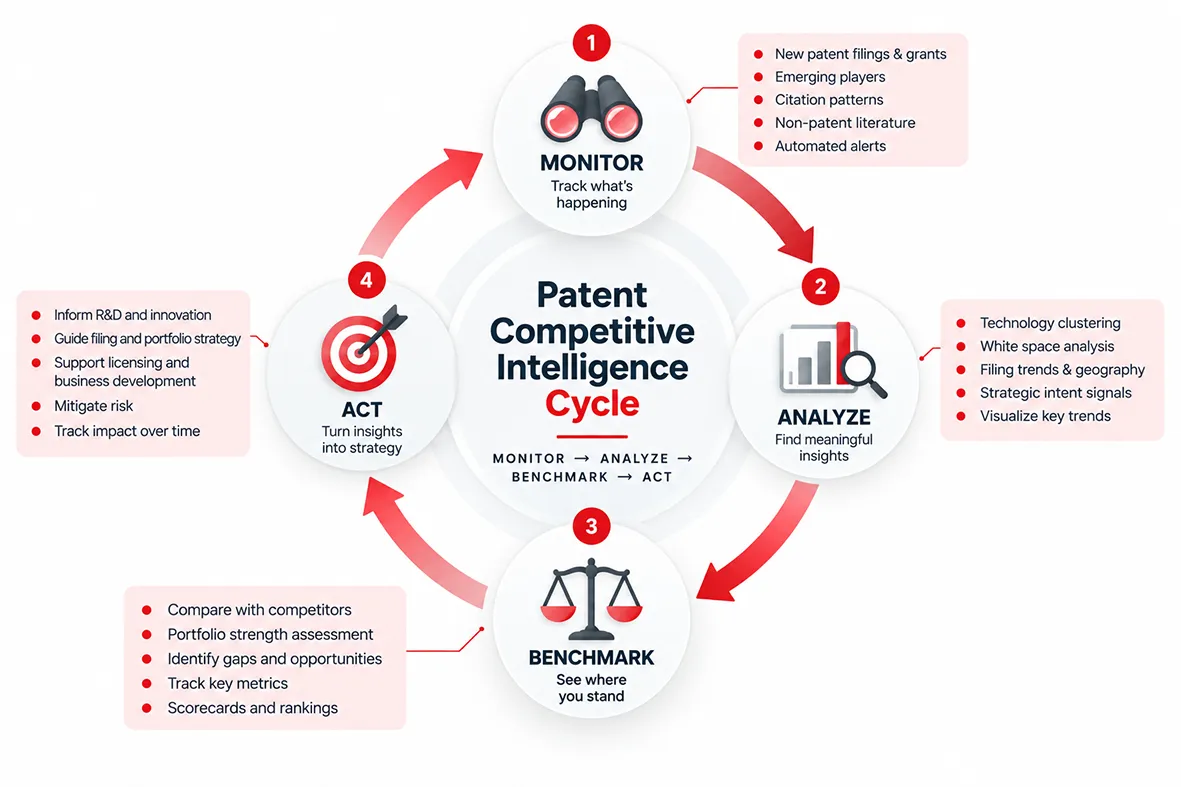
The 4-Stage Patent Competitive Intelligence Cycle
Stage 1: Monitor
Track new patent filings, publications, and non-patent literature from named competitors and from unnamed emerging players in your technology space. This is where most teams under-invest — patent monitoring done manually, by checking a database every quarter, misses the filings that matter most: the ones published between your check-ins. Setting up automated patent alerts closes that gap by surfacing relevant new filings the day they publish rather than the day someone remembers to look.
- What good monitoring covers:
- Direct competitors’ new applications and grants
- Adjacent players entering your technology space for the first time — a signal often missed entirely by monitoring only « known » competitors
- Citation patterns (who is citing whose patents, and how often)
- Non-patent literature — R&D papers, conference proceedings, product launches — which frequently telegraphs a competitor’s direction months before a patent application publishes
Stage 2: Analyze
Raw filing data isn’t intelligence until it’s clustered and contextualized. This stage answers: what does this activity actually tell us?
- Technology clustering — group filings by sub-technology to see where R&D investment is concentrating. Understanding why data clustering is important is foundational here, since a flat list of hundreds of filings tells you nothing until it’s organized into meaningful technology buckets.
- White space analysis — identify technology areas competitors have not filed in, which may represent open opportunity or simply low commercial interest. This is one of the highest-leverage outputs of the analysis stage because it directly informs where your own R&D dollars are least likely to collide with someone else’s blocking patent.
- Filing velocity and geography — is a competitor accelerating filings in a specific jurisdiction ahead of a market entry? A patent landscape analysis built around geography and filing trend, rather than just technology category, often surfaces market-entry signals long before a public announcement.
- Visualization — raw tables of filings are hard to reason about at scale; visualizing the competitive landscape turns hundreds of data points into a map leadership can actually act on in a single meeting.
Stage 3: Benchmark
This is where competitive benchmarking metrics come in — scoring your portfolio against named competitors on concrete, comparable measures. Our dedicated breakdown of competitor benchmarking’s importance, types, and advantages goes deeper into how to structure this scoring exercise.
Benchmarking Metric | What It Reveals |
Filing volume (YoY) | Relative R&D investment trend |
Patent citation strength | Influence and foundational value within the technology area |
Portfolio breadth vs. depth | Diversification vs. specialization strategy |
Grant rate | Application quality and examiner scrutiny patterns |
Geographic filing footprint | Where a competitor intends to enforce or commercialize |
Time-to-grant | Prosecution efficiency and jurisdiction strategy |
Stage 4: Act
Intelligence that doesn’t change a decision is just a report nobody reads. The output of Stages 1–3 should feed directly into:
- R&D prioritization — where to invest engineering resources next, informed directly by the white-space gaps found in Stage 2
- Freedom-to-operate decisions before a product launch, so a promising market entry isn’t blocked by a competitor’s existing claim scope
- Licensing and M&A target identification — patent portfolio monetization strategies increasingly start with a competitive benchmarking exercise that identifies who holds complementary or blocking IP
- Litigation risk assessment — is a competitor building a portfolio that could eventually threaten your roadmap? Patent violation detection tools increasingly plug directly into ongoing CI monitoring rather than running as a separate, reactive exercise
Where Technology Scouting Fits Into the CI Picture
Competitive intelligence is sometimes framed narrowly as « watching named rivals, » but the more valuable version also captures emerging players who aren’t yet on anyone’s competitor list. This is the job of technology scouting — systematically surveying a technology space for new entrants, novel approaches, and early-stage signals rather than just tracking a fixed watchlist. Our overview of technology scouting and its relevance and the related concept of innovation scouting both cover why limiting CI to « the five companies we already worry about » is a common and expensive blind spot — the competitor that disrupts a market is frequently not one of the incumbents being monitored.
Why Competitive Intelligence Matters (Beyond « Staying Informed »)
The benefits compound the earlier they’re built into strategic planning, not just IP operations:
- Earlier warning on competitive threats. A filing surge in your core technology area is typically visible 18–36 months before a competing product reaches market, given average prosecution timelines — enough runway to adjust a roadmap rather than react to a launch.
- Better-informed R&D bets. White space analysis directly reduces the risk of R&D teams re-inventing something a competitor already owns, or worse, investing years into a direction that turns out to be blocked.
- Stronger negotiating position. Knowing a competitor’s portfolio strength — or a specific weakness uncovered through benchmarking — changes leverage in licensing and cross-licensing discussions.
- Litigation preparedness. Teams that maintain ongoing CI are rarely surprised by an infringement claim, because they’ve already mapped competitors’ claim scope well before any dispute arises. This connects directly to how AI is used to enhance litigation outcomes — the same underlying data that powers CI is what a litigation team reaches for first.
- Better technology evaluation decisions. A standalone technology evaluation report is far more credible and defensible when it’s grounded in an ongoing competitive intelligence practice rather than assembled from scratch under deadline pressure.
Common Mistakes That Undermine Patent CI Programs
- Treating it as a one-time report instead of a continuous monitoring cycle — the single most common failure mode described above.
- Analyzing patents in isolation from non-patent literature — competitor R&D signals often show up in conference papers and technical standards before they show up in filings, and a program that only tracks issued patents is structurally always 18+ months behind.
- Benchmarking on volume alone — filing count without citation strength or grant-rate context can be misleading; a competitor filing many low-quality applications isn’t necessarily ahead, and treating raw counts as a scoreboard leads to bad strategic conclusions. Going beyond patent search into deeper patent data analytics is what separates a real benchmarking exercise from a vanity metric.
- No feedback loop to R&D — intelligence that stays inside the legal/IP department rarely changes product decisions, no matter how good the underlying analysis is
- Narrow competitor lists — as covered above, limiting monitoring to known incumbents misses the technology-scouting layer where genuinely disruptive entrants first appear.