

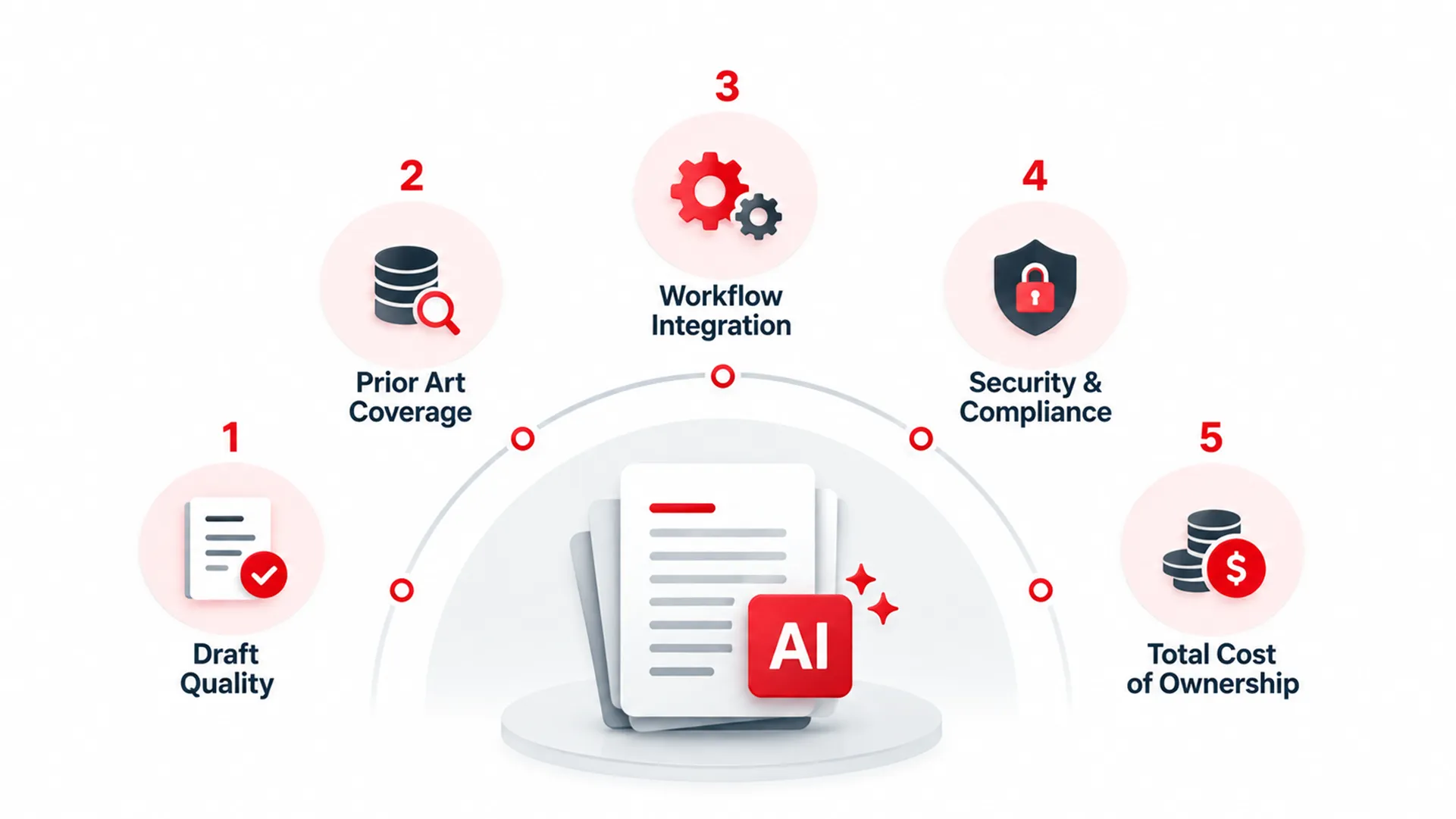
Quick answer: The leading AI patent drafting platforms in 2026 fall into two categories — end-to-end lifecycle platforms that combine drafting with prior art search, prosecution, and invalidity analysis (e.g., XLSCOUT, Patlytics, PatSnap), and focused drafting tools built primarily to convert claims into full specifications (e.g., PatentPal). The right choice depends less on brand recognition and more on five concrete criteria: draft quality, prior art coverage, workflow integration, security/compliance, and total cost of ownership.
Preparing a single patent application can take 40–100+ hours of attorney and agent time. Understanding how much a patent actually costs makes it obvious why that time matters — attorney hours are the single largest line item in most filing budgets. AI drafting tools that reduce that time by even 30–50% on repeatable tasks — backgrounds, summaries, term definitions, embodiment descriptions — free up scarce attorney time for the judgment calls software still can’t make. Below, we compare the field and give you a practical evaluation checklist.
Why AI Patent Drafting Has Become Standard Practice
The shift isn’t just about speed. Our overview of how LLMs and generative AI are transforming patent processes covers the broader context: patent offices worldwide are seeing rising application volumes, and the transformative power of large language models in patent offices is reshaping expectations on both the filing and examination sides simultaneously. Firms and in-house teams that haven’t adopted AI-assisted drafting are increasingly competing against those that have — not just on cost, but on turnaround time for time-sensitive filings ahead of a product launch or a competitor’s anticipated disclosure.
There’s also a legitimate question worth addressing directly: will attorneys who use AI patent drafting replace attorneys who don’t? The honest answer from the field so far is that AI is best positioned as an accelerant for legal judgment, not a replacement for it — every platform discussed below is built around producing an attorney-ready first draft for review, not a final filing without human oversight.
How AI Patent Drafting Tools Differ
|
Platform Type |
What It’s Built For |
Best Fit |
|
End-to-end IP intelligence + drafting |
Prior art search, drafting, invalidity/FTO, and portfolio analytics in one workspace |
Corporate IP teams and firms wanting a single connected workflow |
|
Prosecution-first drafting |
Claim generation, specification alignment, office-action support |
Firms with high drafting volume and standardized workflows |
|
Specification generators |
Converting existing claim language into full written sections and figures |
Teams that already have strong claims and need faster spec writing |
|
Enterprise IP management + analytics |
Portfolio-wide dashboards, docketing, rejection tracking (e.g., forward-rejection insights) |
Large firms managing thousands of active matters |
Comparison Snapshot (2026)
Feature and positioning summary based on publicly available vendor information as of 2026 — always confirm current capabilities and pricing directly with each vendor before purchasing.
|
Platform |
Core Strength |
Notable For |
|
XLSCOUT (Drafting LLM) |
Connects drafting to prior-art and invalidity data in one platform |
Broad combined patent and non-patent literature coverage across 100+ jurisdictions; SOC 2 Type II certified; explainable-AI approach to surfacing supporting evidence |
|
PatSeer |
Broad global data coverage with hybrid AI + Boolean search |
Extensive patent and design-registration coverage across 116+ jurisdictions; quote-based enterprise pricing |
|
PatSnap |
Full innovation-lifecycle platform (research → protection → commercialization) |
AI agents for novelty, FTO, and competitive landscape analysis alongside drafting support |
|
Anaqua |
Enterprise IP management and docketing at scale |
Forward-rejection insight to flag likely §102/§103 examiner rejections early |
|
Solve Intelligence |
Browser-based collaborative drafting |
Emphasis on security and real-time collaborative review |
|
PatentPal |
Converts existing claims into full specifications |
Figure/diagram auto-generation from claim language; browser-native workflow |
For a deeper look at how a connected platform actually works in practice rather than as a feature list, the 3 stages of AI-powered patent drafting walks through the process end to end, from initial disclosure through to a reviewable draft.
5 Criteria to Evaluate Before You Buy
1. Draft Quality
Does the tool produce claim structures and specification language an attorney can review and file with minimal rewriting — or does it produce a rough first pass that still requires heavy editing? Ask any vendor for a sample draft on a real (non-confidential) invention disclosure before committing. Our piece on enhancing patent quality with AI drafting tools outlines the specific quality markers worth checking for — consistent terminology across claims and specification, properly nested dependent claims, and embodiment descriptions that actually support the broadest claim language rather than narrowing it inadvertently.
2. Prior Art Coverage
Draft quality is only as good as the prior art the tool can see. A platform with shallow non-patent literature coverage will miss the academic papers and technical standards that most often sink an application during examination or, later, during an invalidity challenge. Ask specifically about patent and NPL database size, and jurisdiction breadth — and if possible, request a benchmark comparison; our own AI vs. keyword patent search benchmark shows how much relevant prior art a keyword-only search can miss compared to a semantic, AI-driven one, and the same gap applies directly to the prior art feeding a drafting tool.
3. Workflow Integration
A drafting tool that lives in isolation from your prior art search and prosecution tracking creates re-entry work — exporting and re-uploading between systems. Look for platforms where a novelty search, the draft, and later claim chart work for enforcement all sit in one connected environment. This matters even more once you’re managing an active portfolio — see our guide on what a patent portfolio is and why you need one for why disconnected point-tools tend to create expensive blind spots as a portfolio scales.
4. Security & Compliance
Unfiled inventions are your most sensitive IP asset before a filing date. Confirm SOC 2 Type II (or equivalent) certification, data residency options, and clear contractual guarantees around how your invention data is used or retained — especially if the platform uses any shared or fine-tuned models. This is not a box-ticking exercise: a leak of an unfiled invention disclosure can destroy novelty before you ever file.
5. Total Cost of Ownership
Compare per-seat vs. per-draft pricing models against actual attorney hours saved, not sticker price alone. A higher per-seat cost can still be cheaper overall if it materially cuts drafting time on high-volume filing programs; enterprise platforms in this space commonly start in the $900+/user/quarter range for full-featured plans. XLSCOUT’s own pricing page is a useful reference point for how these platforms typically structure tiers around usage volume and module access.
Automated Drafting and Application Speed
One of the most concrete, measurable benefits of AI drafting is turnaround time. Our analysis of how automated patent drafting speeds up the application process breaks down where the time savings actually come from — largely the repetitive, high-volume sections (background, summary, definitions, embodiment variations) rather than the claims themselves, which still require the most attorney judgment. Understanding this distinction helps set realistic expectations: a tool that claims to « draft your whole patent instantly » is either overselling the claims-drafting piece or under-delivering on review quality — the credible platforms are explicit that claims still need substantial attorney input.
Questions to Ask Any Vendor During Evaluation
|
Question |
Why It Matters |
|
« Can I see a draft on a real, non-confidential invention? » |
Tests actual draft quality, not marketing claims |
|
« What’s your non-patent literature database size and jurisdiction coverage? » |
Determines blind spots in prior art awareness |
|
« What’s your data retention and confidentiality policy for unfiled inventions? » |
Critical before a filing date establishes priority |
|
« Does drafting connect to your prior art search and invalidity tools, or is it standalone? » |
Determines whether you’ll re-enter data across systems |
|
« What’s the pricing model — per seat, per draft, or per application? » |
Determines real cost at your filing volume |
|
« How does the tool handle claims specifically, versus the specification? » |
Claims require the most legal judgment — vet this separately from spec-writing speed |